Loading

The Other Economy of AI
·4 min read
Research from the Institute for Human-Centered Artificial Intelligence (HAI) found that private investment in generative AI reached $33.9 billion in 2024. The largest share went to the companies building the models, supplying the compute, and manufacturing the chips on which both depend. This has been the case since 2020, It is the more visible and loudest aspect of the AI economy. The other aspect of it runs quietly underneath it, and concerns the industry-specific systems that translate the general capabilities of the models into a working process. Applications, vertical products, and workflows redesigned around a model rather than decorated with one, are going to determine whether the enterprise value everyone has been promised will actually arrive. That is to say, the value of using AI lies in the money companies recover when those models are wired into a real business process. By that measure, most value has only been partly obtained.
Why AI Adoption Is Not Delivering Returns Yet
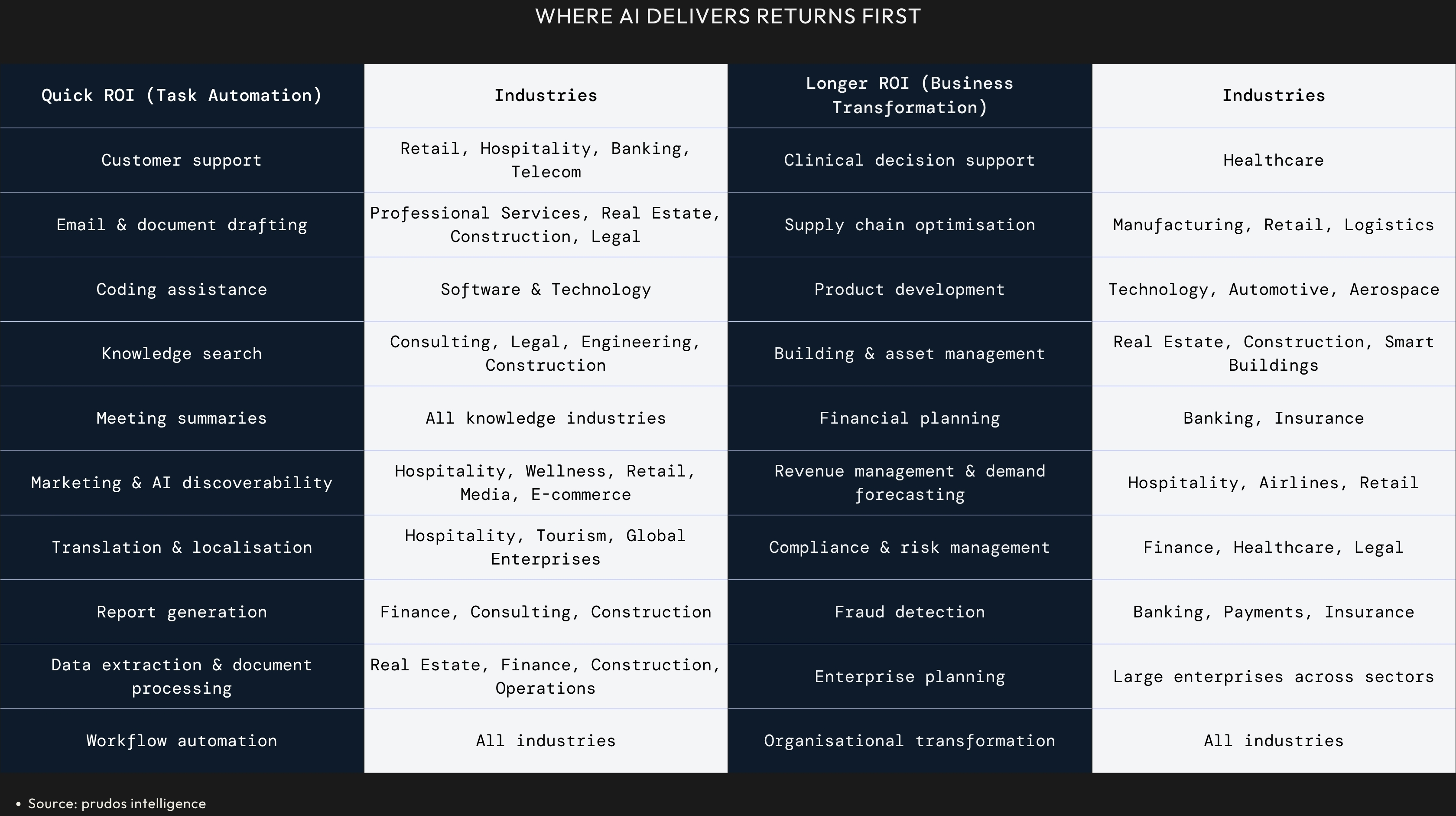
The majority of the organizations using generative AI in at least one function, still report no measurable effect on earnings at the enterprise level. Which is explained by one variable: what was the technology used for specifically? Is it being used for functions that can show quick productivity gains and time saving workflows? or is it being used for processes that take time to mature and materialize?
The OECD's firm-level research on the adoption of Artificial Intelligence confirms this. Firms achieve the greatest productivity gains when they redesign processes around AI rather than applying the technology to existing ways of working. Without that organisational change, AI often delivers incremental improvements rather than fundamental gains. Return arrives only when a company is willing to rebuild the process itself, which is slow, unglamorous, and not always immediately visible.
Two examples illustrate the difference. Klarna, the Swedish payments company, reported in early 2024 that an AI assistant integrated into its customer service operations was handling the workload of around 700 full-time agents and resolving queries in minutes, compared with an average response time of 11 minutes previously. The improvement came not simply from deploying a better chatbot, but from redesigning the support process around the capabilities and limitations of the model.
IBM’s Watson for Oncology shows how "innovation" is not automatically synonymous with "improvement". Marketed to hospitals in the mid-2010s as a system designed to support cancer treatment decisions, the tool struggled when clinicians found that its recommendations did not always align with the needs of individual patients. The issue was not the technology itself, but the gap between the system and the way clinical decisions were actually made.